February 24, 2026
Barefoot Training: The Hidden Science of Foot-Ground Force Transfer
Modern lifting shoes are sensory-deprivation chambers for your feet. Learn how barefoot training restores proprioception, fixes energy leaks, and maximizes force production in your heavy compounds.
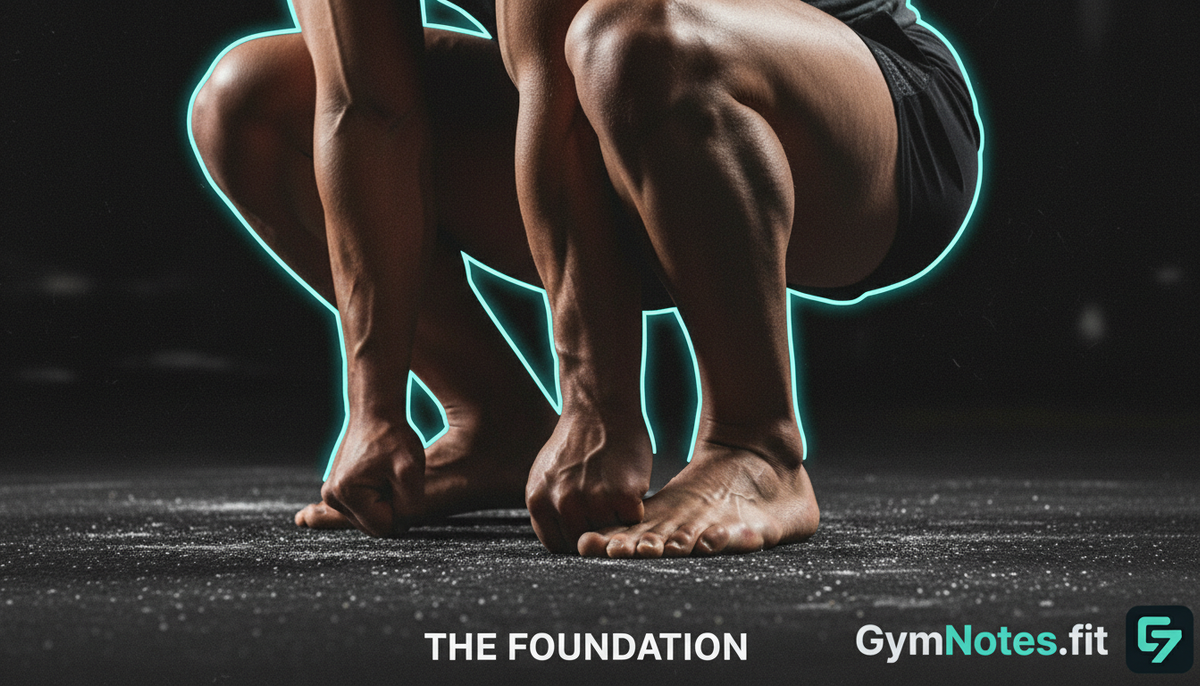
The Barefoot Blueprint: Why Your Expensive Lifting Shoes are Killing Your Squat
For decades, the fitness industry has sold us on the necessity of high-tech, over-engineered lifting shoes. But while your $200 lifters might give you a temporary ego boost on the platform, they may be creating a silent crisis for your long-term hypertrophy and joint health. If you aren't training barefoot—or at least in minimalist footwear—you are leaving mechanical gains on the table.
The Biomechanical Braking System
Traditional athletic shoes are built with thick midsoles, excessive arch support, and narrow toe boxes. From a sports science perspective, this is a recipe for sensory deprivation. Your feet contain over 100 muscles, tendons, and ligaments, along with 200,000 nerve endings. When you encase them in a padded coffin, you diminish the proprioceptive feedback required for optimal force production.
A landmark study by Mullen et al. explored the mechanics of the "foot-ground interface." The research suggests that barefoot training enhances the recruitment of the intrinsic foot muscles, which directly impacts the stability of the kinetic chain. When your foot is stable and "active," your knees and hips move through a more natural, efficient path. This isn't just about "feeling the floor"—it's about maximizing the efficiency of every Newton of force you drive into the platform.
Proprioception and Power Output
When training barefoot, you engage the "short foot" posture, pulling the ball of the foot toward the heel to create a rigid arch. This stability prevents "energy leaks" during heavy compounds like squats and deadlifts. In cushioned shoes, the slight compression of the foam absorbs a fraction of your force before it ever moves the barbell. Barefoot training removes the middleman, ensuring 100% of your power goes exactly where it belongs: into the load.
Furthermore, recent biomechanical analyses indicate that barefoot squatting can lead to increased muscle activation in the posterior chain. Without the artificial heel lift of a weightlifting shoe, your body is forced to rely on genuine ankle mobility and glute recruitment. You aren't just lifting the weight; you're teaching your nervous system how to command your entire frame.
⚡ The GymNotes.fit Takeaway
- Ditch the Padding: Transition slowly to barefoot or minimalist footwear (0mm drop) to re-sensitize your nervous system and increase force transfer efficiency.
- Build the Arch: Practice "active foot" drills—clawing the floor with your toes—to create a stable base for heavy axial loading like squats and overhead presses.
- Ankle Prehab: If you’ve spent years in lifters, your ankle mobility may be compromised. Use barefoot warm-ups to restore natural dorsiflexion before your heavy working sets.