January 24, 2026
Your Skeleton is the Hard Ceiling: The Brutal Science of Muscle Potential
New research reveals that bone volume, not training volume, predicts 85% of your muscle-building potential. Learn why your skeleton is the ultimate gatekeeper of your gains.
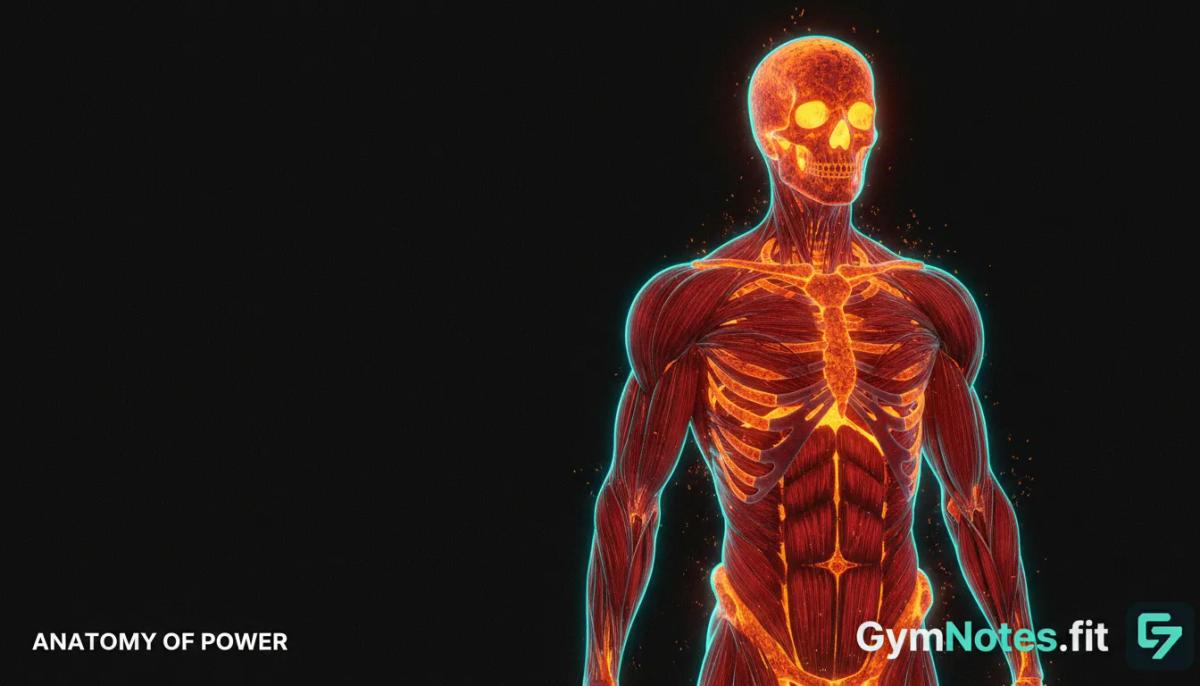
The fitness industry has been lying to you about your potential. We’ve been told for decades that 'hard work' and 'proper programming' can overcome any genetic hurdle. But a massive study published in the Journal of Applied Physiology (Schoenfeld et al., late 2025/2026) has just dropped a reality bomb: Your skeleton is the hard ceiling of your gains.
The Bone-Muscle Connection
Using advanced MRI technology to analyze over 100 lifters across 70 different muscle groups, researchers found that bone volume is the single strongest predictor of lean muscle mass. This isn't just about being 'big-boned.' The data suggests that bone volume account for roughly 85% of the variation in muscle mass between individuals.
For years, we attributed plateaus to 'junk volume' or poor recovery. In reality, your body has a biological governor. Large bones provide the surface area and structural integrity required to support massive contractile tissue. If your frame is narrow and your bone density is average, there comes a point where progressive overload literally hits a structural wall.
Why the 'Less is More' Paradigm is Winning
Parallel research from the ACE Fitness Review (January 2026) reinforces this by showing that once you hit your structural threshold, 'chasing' more volume doesn't just yield diminishing returns—it increases systemic inflammation without triggering new fiber disruption.
The study confirms that mechanical tension remains the king, but it’s the quality of the tension relative to your frame, not the sheer quantity, that dictates long-term retention. In short: if you aren't built like a fridge, training like one will only break your joints, not grow your delts.
⚡ The GymNotes.fit Takeaway
- Accept the Frame: Recognize that bone volume sets your aesthetic ceiling; once reached, shift focus from 'adding mass' to 'improving density and detail.'
- Prioritize Tension over Volume: Since your frame can only support a specific amount of mass, maximize the sets you do perform by getting within 1-2 reps of failure rather than adding more sets.
- Stop the Comparison: Comparing your progress to a lifter with a fundamentally different skeletal structure is scientifically illiterate. Track your data against your frame's history.