January 20, 2026
The Hypertrophic Efficiency Ceiling: Why More Volume is Not the Answer (2025-2026 Research Update)
New 2025-2026 research from Florida Atlantic University and the Journal of Applied Physiology reveals the 'Hypertrophic Efficiency Ceiling.' Learn why 'more' volume is killing your gains and how to calculate 'Direct vs. Indirect' sets for maximum growth.
The pursuit of hypertrophy has long been dominated by the 'more is better' dogma. However, groundbreaking 2025 research from Florida Atlantic University and recent meta-regressions (Schoenfeld et al., 2025) are forcing a radical paradigm shift in how we quantify effective training volume. We are entering the era of 'Volume Precision.'
The Law of Diminishing Returns: The 2025 Meta-Regression
For years, the '10-20 sets per muscle per week' guideline was treated as gospel. However, a major 2025 meta-analysis published in the Journal of Applied Physiology has redefined the upper limit of productive volume. The data suggests that for trained individuals, the growth curve flattens significantly after just 6-8 direct sets per session. Beyond this point, systemic and local fatigue accrue at a rate that far outpaces protein synthesis signaling. This is what we call the 'Hypertrophic Efficiency Ceiling.'
Direct vs. Indirect Volume: The Precision Model
A critical distinction made in the latest literature (notably by researchers at FAU in June 2025) is the differentiation between 'Direct' and 'Indirect' volume. Previously, if you did a Bench Press, your triceps were often credited with a 'full set.' The 2025 findings suggest that indirect stimulation provides only ~30-50% of the hypertrophic signal compared to direct isolation. This means your 'junk volume' isn't just inefficient; it's miscalculated. To optimize, you must prioritize direct, high-tension axial-loaded movements over a scattergun approach of secondary accessory movements.
The Molecular Rewiring: Epigenetics of the Lift
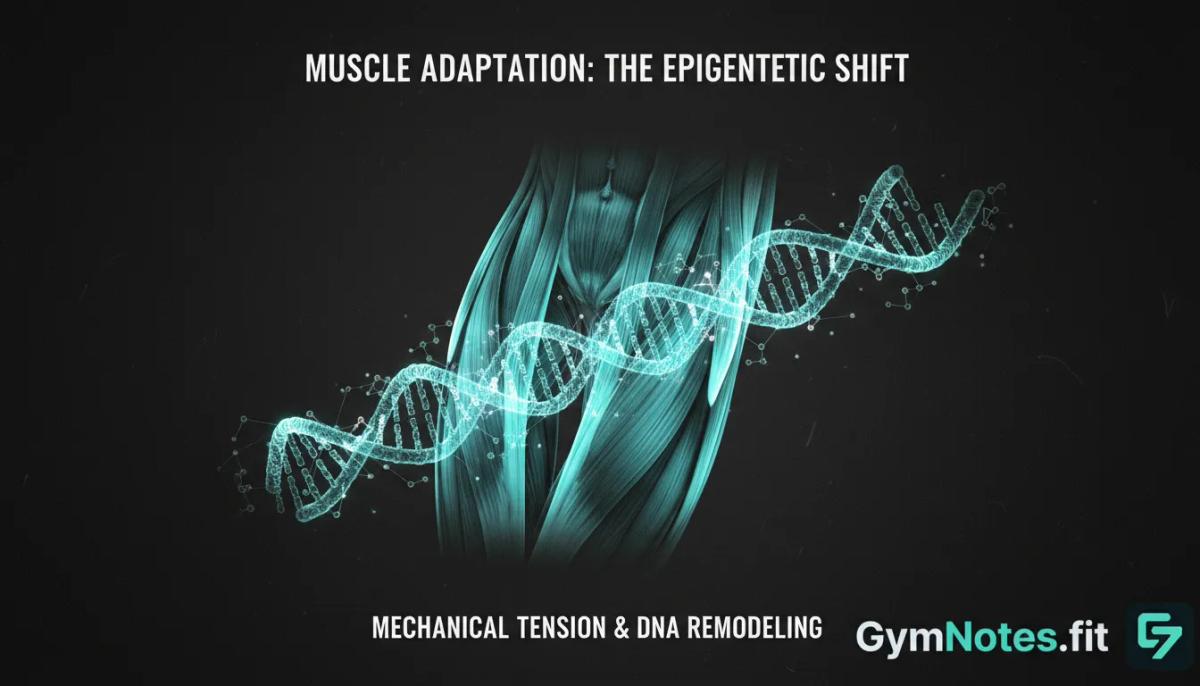
In January 2026, emerging research has highlighted that the benefit of exercise extends beyond myofibrillar hypertrophy. A study published in early 2026 indicates that intensive resistance training actually 'rewires' the body at a molecular level, altering DNA methylation patterns associated with metabolic health. This 'molecular memory' suggests that high-quality, high-intensity sets (RPE 9-10) are superior to high-volume, low-intensity sets for long-term physiological adaptation.
Practical Application: The 2026 Precision Protocol
Based on the current data, your hypertrophy protocol should shift toward:
- Intensity over Accumulation: Focus on 2-3 high-quality sets per exercise, targeting an RPE of 9 or 10, rather than 5 sets at RPE 7.
- Lengthened State Prioritization: In line with the 2025 data on stretched-mediated hypertrophy, ensure your primary lifts emphasize the eccentric-to-concentric transition where the muscle is most elongated.
- Volume Capping: If you cannot complete a session within 60-75 minutes while maintaining peak force output, you are likely crossing into 'junk volume' territory that hampers recovery.
Summary: The science of 2026 is clear—muscle growth is not a tally of how much work you can survive, but a measure of how much high-tension mechanical signal you can precisely deliver to a target tissue without overwhelming your recovery capacity. Stop counting sets; start counting stimulus.