April 29, 2026
The Muscle Memory Myth: New Science Reveals Your Muscles Never 'Forget' a Workout
New research reveals that muscle memory isn't just in your head—it's written into your proteins. Discover how your body 'saves' your gains even when you stop training.
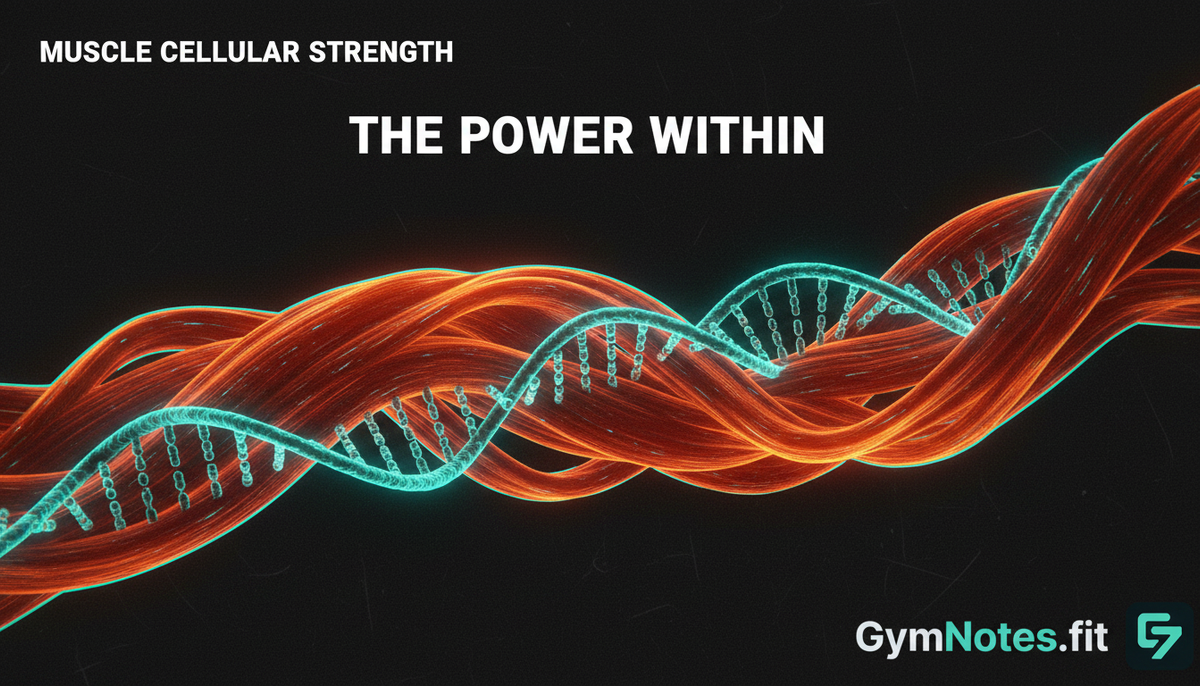
Training hard for a few months, only to lose it all after a vacation or a busy stint at work, is the ultimate fear of every serious lifter. But what if your muscles were actually keeping a ledger of every set you’ve ever done?
The concept of 'muscle memory' has shifted from a locker-room myth to a molecular certainty. While we used to think it was just about 'nervous system efficiency,' groundbreaking research is revealing that your muscle fibers are physically rewritten at a cellular level, even after you stop lifting.
The Proteomic Ledger: Science of the 'Saved' Gains
In a landmark trial (University of Jyväskylä, 2025), researchers tracked over 3,000 different muscle proteins through 10 weeks of intense training, 10 weeks of total detraining (no lifting), and a subsequent retraining period.
The results were shocking: while visible muscle size decreased during the layoff, specific proteins remained 'locked' in their trained state. Most notably, Calpain-2 (CAPN2) and specific calcium-binding proteins did not return to baseline. They stayed elevated, essentially acting as a molecular 'save point' for your physique.
This complements previous epigenetic findings (Seaborne et al.) which demonstrate that resistance training causes DNA hypomethylation. Essentially, the 'tags' on your genes that inhibit growth are removed during training. Even when you stop lifting and the muscle shrinks, those tags do not return. Your genes remain 'unlocked' and primed for growth, allowing for rapid hypertrophy the moment you touch a barbell again.
⚡ The GymNotes.fit Takeaway
- Don't Fear the Deload: A month off won't erase years of work. Your 'protein ledger' and epigenetic tags remain active for at least 60-90 days of inactivity.
- The Persistence of Myonuclei: Training increases the number of nuclei in your muscle fibers. These nuclei do not disappear during detraining, making retraining significantly more efficient than starting from scratch.
- Invest in the 'Bank': Every hard training cycle is a permanent investment in your genetic potential. You aren't just building temporary tissue; you are permanently altering your muscle's ability to grow.
Even if you look 'flat' after a break, your cellular machinery is still tuned for high performance. Your gains aren't gone; they're just on standby.