January 13, 2026
The Stability Bottleneck: Is the Standing OHP Killing Your Gains?
Is the standing OHP killing your gains? We dive into the biomechanics of stability vs. tension and why the seated press might be superior for shoulder mass.
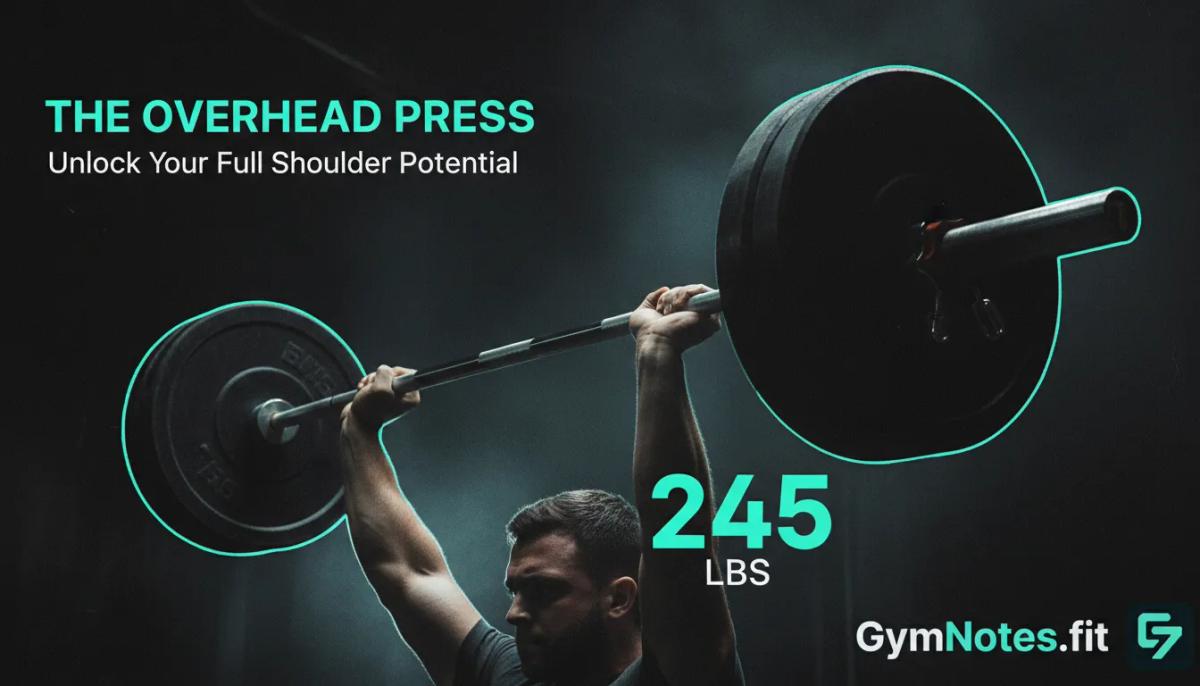
The Vertical Press Dilemma
For decades, the standing Overhead Press (OHP) was the undisputed king of upper-body strength. If you wanted broad shoulders, you pressed a barbell over your head. But as the focus of the lifting community shifts toward hypertrophy-specific data, a uncomfortable question has emerged: Is the standing OHP actually a sub-optimal choice for building muscle?
Recent research, including meta-analyses by experts like Brad Schoenfeld and new data from early 2025, suggests that for pure hypertrophy, we need to reconsider the 'Stability-Tension Tradeoff.'
The Stability-Tension Tradeoff
In the world of biomechanics, mechanical tension is the primary driver of muscle growth. However, your nervous system acts as a governor; if it senses instability, it will down-regulate the motor unit recruitment to the target muscle to prevent injury.
When you perform a standing OHP, your core, glutes, and even your feet are working overtime to keep you from toppling over. While this is great for 'functional' strength, it creates a stability bottleneck. Your deltoids may be capable of pushing 150 lbs, but if your core stability can only support 135 lbs in a standing position, your shoulders will never experience the maximum mechanical tension they are capable of handling.
What the Science Says: Seated vs. Standing
A pivotal study compared muscle activation in the seated dumbell press, standing dumbell press, seated barbell press, and standing barbell press. The findings were revealing:
- High Activation, High Fatigue: The standing versions showed high EMG activity, but often resulted in earlier failure due to postural fatigue rather than local muscle failure in the deltoids.
- The Seated Advantage: Seated variations (with back support) allowed lifters to move roughly 10-15% more weight. This extra load translates directly into greater mechanical tension on the anterior and medial deltoids.
The Overhead Press Analysis
Does this mean you should delete the OHP from your GymNotes app? Not necessarily. It means you need to define your objective:
- Objective: Total Body Power. Stick to the standing OHP. It teaches the body to work as a single unit and develops massive 'bracing' strength.
- Objective: Shoulder Hypertrophy. Transition to the Seated Barbell Press or Seated Dumbbell Press. By removing the stability requirement of the trunk, you allow the shoulders to become the limiting factor of the set.
Productivity in the Gym: Stopping Junk Reps
One of the biggest issues with the standing OHP in a hypertrophy context is 'technique breakdown camouflage.' As you get tired, it is easy to start using leg drive (turning it into a push press) or excessive lumbar extension (turning it into a standing incline bench press). These 'junk reps' increase injury risk without significantly contributing to shoulder growth.
By moving to a seated position, you isolate the movement. The data reflects a cleaner RPE (Rate of Perceived Exertion) because when you hit a wall, it is truly your shoulders failing, not your lower back arching in a desperate attempt to move the weight.
The GymNotes Recommendation
If your goal is to maximize the efficiency of your training session, stop viewing the OHP as a mandatory 'foundation' lift. In your next block, try substituting the standing OHP with a high-incline seated press (set at 75-80 degrees). Track your volume and weight in GymNotes. You will likely find that your total tonnage increases, and the 'mind-muscle connection' in your deltoids becomes significantly more pronounced.
Strength is a skill, but size is a physiological response to tension. Don't let a lack of stability hold your gains hostage.